




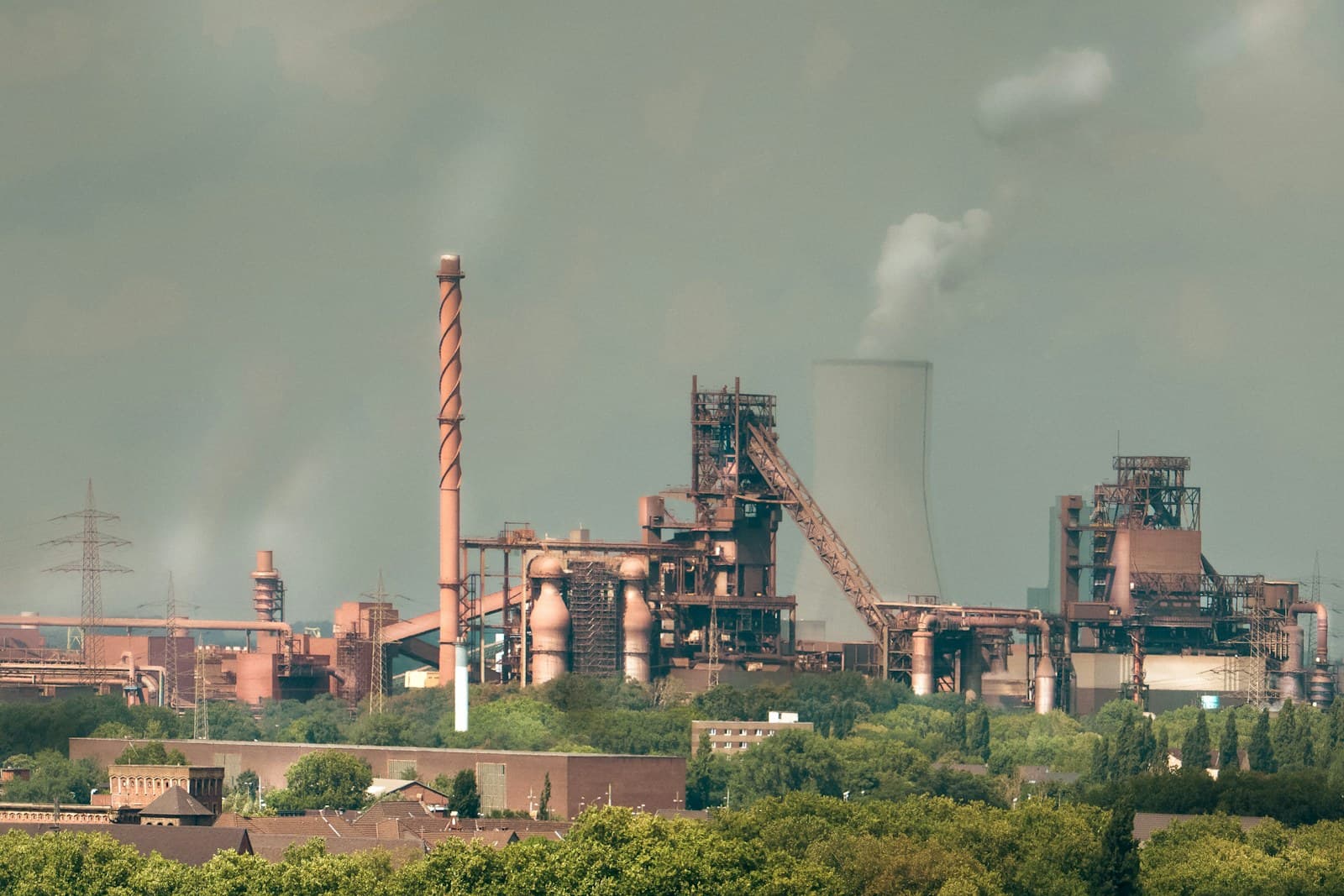
Pressure to cut emissions is moving closer to every factory, from domestic greenhouse-gas inventory requirements to increasingly stringent carbon standards in international markets. But knowing that emissions must fall is one thing; turning that goal into tonnes of CO₂ actually avoided is another. For many manufacturers, the bottlenecks sit directly in their data, capital, technology and even the electricity they use every day.
When carbon is no longer only an environmental issue
For manufacturers, emissions reduction could once be treated as part of a corporate social-responsibility program or a sustainability strategy. That view is changing rapidly.
Under Vietnam’s updated 2022 Nationally Determined Contribution, the country aims by 2030 to reduce total greenhouse-gas emissions by 15.8% compared with the business-as-usual scenario using domestic resources; the reduction could reach 43.5% with appropriate international support. Energy and industrial processes are among the priority areas of this pathway.
Pressure is gradually becoming a concrete obligation for businesses. Vietnam has introduced greenhouse-gas inventories for major emitting facilities while progressively developing emissions quotas and a carbon market. In February 2026, 110 facilities in thermal power, cement and iron and steel were allocated pilot emissions quotas for the 2025–2026 period.
Decision 42/2026/QD-TTg further updates the list to 2,441 facilities required to conduct greenhouse-gas inventories, most of them in the industry and trade sector. The Decision takes effect on 25 September 2026.
Pressure also comes from beyond Vietnam’s borders. From 1 January 2026, the European Union’s Carbon Border Adjustment Mechanism (CBAM) entered its definitive phase for several emissions-intensive product groups including iron and steel, aluminum, cement, fertilizers, electricity and hydrogen.
Carbon is therefore becoming a variable in both the cost equation and the competitiveness of businesses. Yet when factories begin trying to cut emissions, many run into a very basic question: where should they start?
Bottleneck 1: Incomplete and fragmented emissions data
A factory may know how much it pays for electricity each month, how many tonnes of coal it uses or how much raw material it consumes. But accurately identifying which production stage generates the most emissions is far from simple.
Data needed for greenhouse-gas inventories are often scattered across departments: accounting keeps energy bills, engineering manages equipment, production holds operating data, purchasing has raw-material information, while transport data may sit with an external supplier. More importantly, most of these data were not originally collected for emissions calculations.
In 2026 activities with industrial enterprises under Vietnam–Germany cooperation, limitations in primary data, secondary data and energy-metering systems continued to be identified as difficulties in greenhouse-gas inventory preparation and energy management.
Without identifying emissions ‘hotspots’, businesses can easily invest by intuition: replacing a device believed to save electricity without knowing whether it is actually the place that can deliver the greatest emissions reduction.
That is why a greenhouse-gas inventory should not be seen merely as a report that must be submitted. Emissions data are the map that tells a business where its carbon-reduction capital should go.
Bottleneck 2: Lack of capital for emissions-reduction projects
Cutting emissions costs money. For manufacturers, however, capital is always competing among multiple priorities. A factory considering an investment of VND 20 billion may have to choose between adding a production line to increase output, buying new equipment to serve an order, or replacing an existing system with energy-efficient technology.
The first two investments usually show direct revenue. The third creates benefits through electricity, fuel and carbon costs saved over many years. This is precisely why many emissions-reduction projects that make technical sense still struggle to pass investment approval.
Vietnam’s Ministry of Industry and Trade has noted that industrial energy-saving potential remains substantial, but many projects face long payback periods, limited access to suitable finance and uneven project-development capacity among businesses.
UNIDO’s industrial decarbonization roadmap for Vietnam also identifies constraints in financing for energy-efficiency projects and technology transition.
At the macro level, the financing need is much larger. The World Bank estimates that Vietnam needs about USD 114 billion for decarbonization during 2022–2040, including around USD 64 billion for the energy transition alone; industry, transport and agriculture require roughly another USD 17 billion. The figures underline a reality: the green transition will be difficult to accelerate if emissions-reduction projects are not investable enough to attract capital.
Bottleneck 3: Deep-decarbonization technologies remain difficult to deploy
Not every tonne of CO₂ costs the same to eliminate. In the early stages, businesses can begin with relatively familiar measures: high-efficiency motors, reducing compressed-air leaks, optimizing boilers, improving refrigeration systems, recovering waste heat or adjusting machine operating schedules.
Many of these measures can reduce both emissions and energy bills. But once the easy opportunities have been captured, the path ahead becomes more difficult.
To achieve deeper reductions, a business may need to electrify heat-consuming processes, change fuels, shift to low-carbon feedstocks or even replace an entire production process.
In cement, emissions come not only from burning fuel but also from the clinker-production process. In steel, a large share of emissions is tied to the metallurgical technology itself.
At that point, the challenge is no longer simply ‘replace one machine’. UNIDO identifies limited technical capacity, skills and experience with low-carbon technologies as one of the barriers to industrial decarbonization in Vietnam.
For a factory already operating steadily, new technology is truly viable only when it can meet four requirements at once: cut emissions, maintain quality, avoid disrupting production and offer an acceptable path to payback.
Bottleneck 4: Clean electricity is still not easy for businesses to access
For many manufacturing sectors, a significant share of emissions comes from electricity. The answer therefore appears straightforward: use more renewable power.
Reality is more complicated. World Resources Institute research on industrial decarbonization in Vietnam shows that corporate demand for clean electricity is rising, while electricity costs, supply reliability and grid infrastructure remain factors businesses must weigh.
Vietnam established a direct power purchase mechanism between renewable generators and large electricity users through Decree 57/2025/ND-CP, later further adjusted by Decree 243/2026/ND-CP. This is a significant step forward. But having a direct power purchase mechanism does not mean every factory can immediately switch to 100% renewable electricity.
Factory location, transmission infrastructure, load profile, renewable supply, power-purchase contracts and costs all affect the ability to transition. In other words, a business may do everything well inside the factory fence and still depend on how quickly the external energy system becomes greener.
Bottleneck 5: Shortage of specialized human resources
Emissions reduction is an interdisciplinary problem. Engineers understand production lines but may not be proficient in greenhouse-gas inventory methods. Environmental teams can prepare reports but are not necessarily the people who decide whether to replace a production line worth tens of billions of dong. Finance teams can calculate cash flows but may not yet be used to valuing the benefit of every tonne of CO₂ avoided. Purchasing teams increasingly need to consider the emissions of materials and suppliers. When these responsibilities sit across different departments without an empowered focal point to connect them, an emissions-reduction strategy can easily remain on paper.
UNIDO likewise identifies a shortage of people with suitable skills and technical capacity as a barrier to industrial decarbonization. The challenge is therefore not simply to hire another environmental officer. Businesses need to build a new capability: carbon management. That capability requires linking emissions data with engineering, finance, investment and business-strategy decisions.
Bottleneck 6: Market requirements are changing too quickly
An industrial production line may operate for 15–20 years, or even longer. Market requirements, however, can change within only a few years.
In its report Viet Nam 2045: Trading Up in a Changing World, the World Bank estimates that export-related activities account for about one-third of Vietnam’s emissions. As major markets increasingly favor goods with lower carbon footprints, the ability to reduce emissions is becoming part of export competitiveness.
The EU’s CBAM is an obvious example. But the pressure does not stop with businesses exporting directly to Europe. A Vietnamese company supplying components to a multinational may be asked to provide emissions data. A raw-material supplier may need to demonstrate its carbon footprint. An exported product may have to trace emissions across the entire supply chain. This creates a difficult trade-off: investing too early may expose firms to technology risk, while investing too late may cost them market access. Factory investment cycles are becoming longer than the pace at which the ‘carbon rules of the game’ are changing.
There is no single ‘Net Zero shortcut’ for every factory
A steel mill cannot simply copy the roadmap of an electronics company. A heat-intensive facility will not have the same emissions profile as a business that mainly consumes electricity. A newly invested factory may also have very different technological options from a production line that has operated for 20 years. Emissions reduction therefore does not necessarily have to begin with a multimillion-dollar technology project.
A more practical starting point is to build sufficiently reliable data, identify major emissions sources, establish a baseline and calculate the cost of each reduction option. From there, a business can structure its roadmap in layers: measures that can be implemented immediately with quick payback; medium-term investments; and major technology changes that must be prepared years in advance.
On the policy side, requirements for businesses to reduce emissions also need to be matched by access to finance, clean electricity, technology, infrastructure and capable human resources. Ultimately, the biggest bottleneck is not whether businesses have heard of Net Zero.
The challenge is turning a carbon goal into an investment decision that can be measured, financed and implemented on a production line that is already operating. As carbon becomes increasingly linked to costs, trade and market access, the question for manufacturers is also changing: no longer ‘is the green transition expensive?’, but ‘how expensive will delaying the transition become?’
References
- Industry — Energy Efficiency 2025 — International Energy Agency
- An International Framework for Eco-Industrial Parks, Version 2.0 — UNIDO, World Bank Group and GIZ
- GHG Protocol Corporate Standard — Greenhouse Gas Protocol